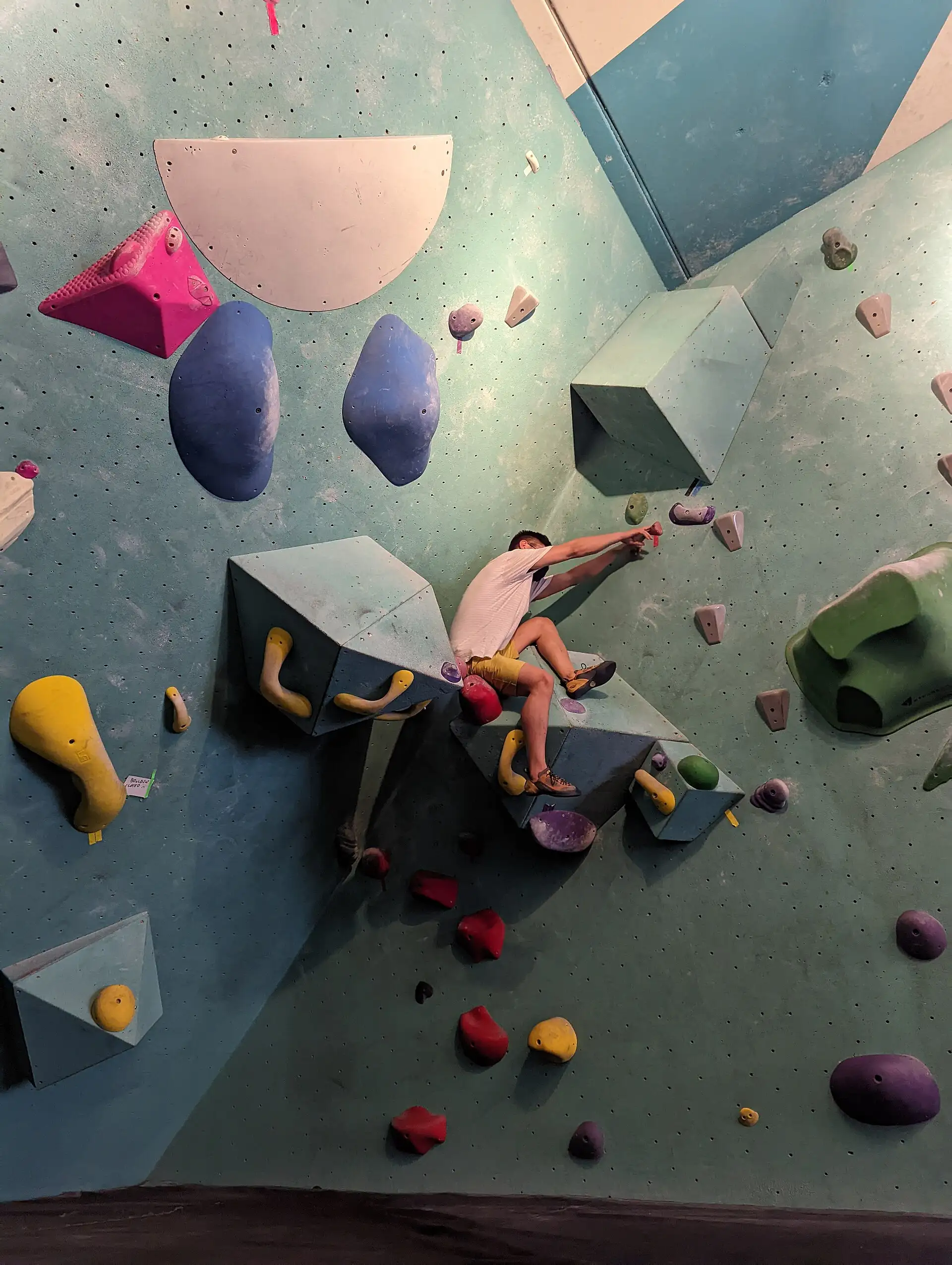
A circuit is a range, not a grade
In a circuit, every climb of one color sits inside the same band of difficulty. The band is usually two or three grades wide, and neighboring bands often overlap, so the hardest blue can be harder than the easiest yellow. Setters pick the color for how a climb fits the band, not for one exact number (Climbing Business Journal).
Gyms choose circuits on purpose. Camp5 says its color scale frees you to try routes within your potential, and lists the grade of each route separately for anyone who wants it (Camp5). Portside Boulders in Perth overlaps its colors so you pick climbs out of curiosity rather than for a number (Portside).
The cost is training. When every purple counts the same, it's hard to tell whether you're improving inside a band, and the same setters' article names that as a circuit's weak spot.
Camp5's colors, easiest first
Same color, different place
There's no shared color code. Each gym ranks its own colors, so the same tape means something different from gym to gym. Pick a color to see where it sits at five gyms on three continents.
Camp5 Malaysia, 8 colors
- Pink
- Blue
- Yellow
- Orange
- Green
- Purple
- Red
- Black
boulder+ Singapore, 7 colors
- White
- Yellow
- Red
- Blue
- Purple
- Green
- Pink
Urban Climb Australia, 8 colors
- Yellow
- Blue
- Purple
- Green
- Orange
- Red
- Black
- White
Mesa Rim San Diego, US, 6 colors
- Green
- Blue
- Yellow
- Red
- Purple
- Black
The Front Utah, US, 6 colors
- Yellow
- Blue
- Green
- Pink
- Red
- Black
Why Ascent never converts a color
A color covers a range, so turning it into one number would invent a precision the gym never gave. Calling every Camp5 purple a V5 would be wrong for the purples that are V4 and the ones that are V6, and it would hide the progress you make inside the band.
So in Ascent a color gym ranks its own colors, from the easiest to the hardest, and a climb's grade is its place in that gym's list. It always shows as the color, never as a number, and no two gyms' colors are ever compared. The same rule holds for every scale: numbered gyms share one 1 to 15 scale with a softer or harder offset per gym, while V, French, Font and kyu and dan grades each keep their own.
How your progress still shows
- A normal color per gym. Ascent suggests it from the middle of what you've sent there over the last 28 days, and you can change it. Your normal is the line every climb is weighed against.
- Load. Each try counts more above your normal and less below it. One step between colors counts as 2.5 grade steps, because each Camp5 color spans about three V grades. The formula is on the training load page.
- Firsts. Your first send of a color at a gym earns a medal, "First Purple", with the gym's name on it.
- Progress. Progress can show one color gym's own colors, so a month of purples and your first red read as what they are.
Your normal color
Purple
Adding a color gym to Ascent
- If your gym is on Ascent's gym list, pick it when you first set up the app and its colors come with it. Otherwise open Settings, then Gyms and boards, and tap Add gym.
- Name the gym and choose the color tags scale. A new gym starts from Camp5's eight colors.
- Put the colors in your gym's order, easiest at the top. Move them up or down, remove the ones it doesn't use, and add any of the nine hold colors it does. A gym needs at least two.
- If the gym later reorders its circuit, move the colors to match. Your past climbs are re-ranked to the new order; a color you've logged climbs on can't be removed.
Gyms already on Ascent's list with color circuits include Camp5 in Malaysia, boulder+, Climba and Kinetics in Singapore, The Bouldering Hive in Manila, BlocHaus, Urban Climb and Portside Boulders in Australia, and Mesa Rim and The Front in the US.