
Every climb has a weight
Ascent counts tries, not sessions, and weighs each try by how hard the climb was for you. "For you" means against your normal grade: the grade you usually send. Ascent suggests it from the middle of your sends on that scale over the last 28 days, and you can set it yourself.
load = tries × 2(grade − normal) ÷ 2
A try at your normal grade weighs 1. Two grades above, it weighs 2; two grades below, half. Tries that don't end in a send count too, because they load your fingers just the same.
A grade step means one step on the gym's own scale: one number, one V grade or one kyu, half a step for French and Font grades, and two and a half for a color in a color circuit, because each color spans about three V grades.
| Climb | Adds |
|---|---|
| One try at your normal grade | 1 |
| One try, two grades above | 2 |
| One try, two grades below | 0.5 |
| Three tries, one grade above | 4.24 |
| Five tries, four grades above | 20 |
Your week against your usual week
Ascent adds up the last 7 days, today included. Your usual week is the average of the 4 weeks before that: the 28 days before the last 7, divided by 4. Both windows roll forward every day, so Load doesn't drop to zero every Monday.
Load needs those 4 weeks of history before it can compare. Until then, Today shows your sessions this week against your weekly target instead.
The 80 to 130% band
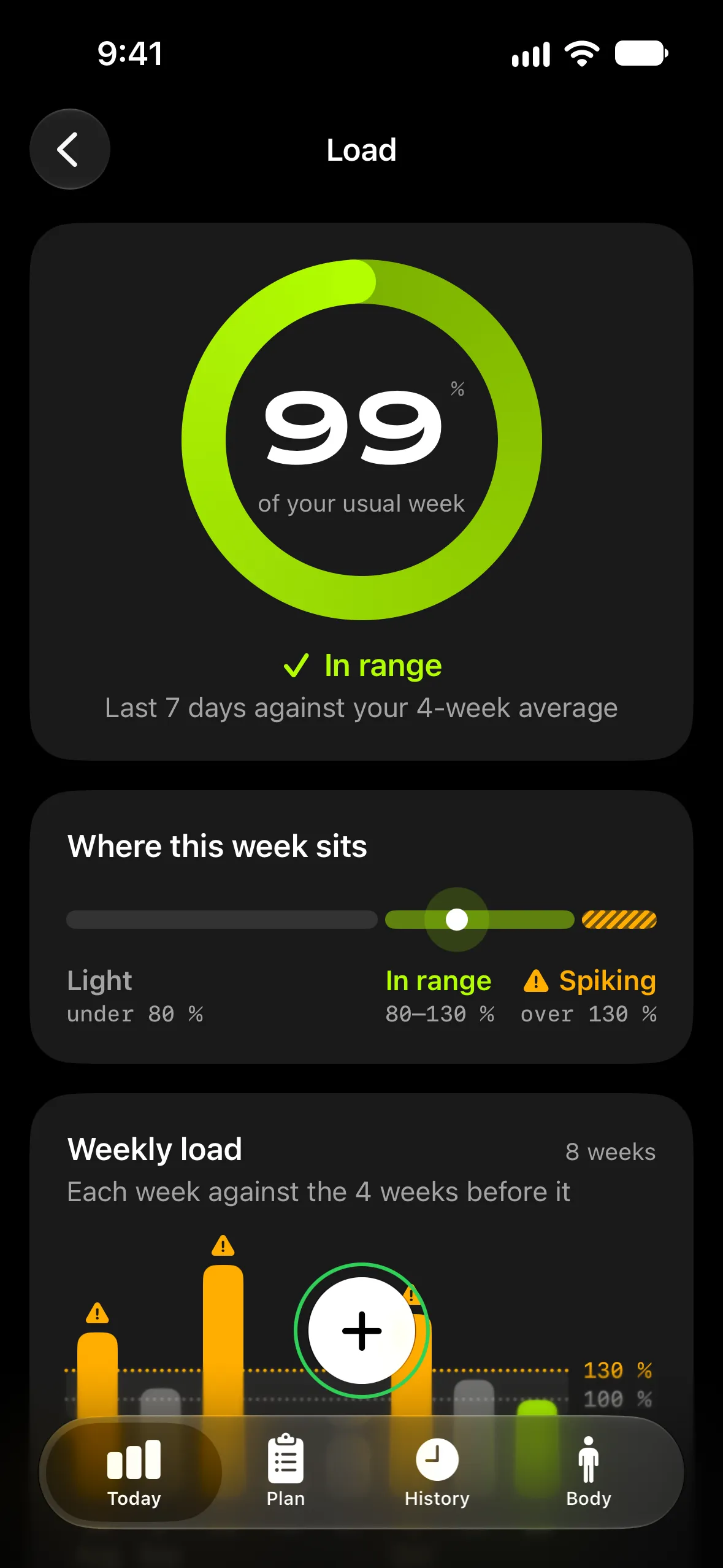
Load is this week as a share of your usual week, in three bands:
Lightunder 80%
In range80 to 130%
Spikingover 130%
A rule of thumb, not a forecast
The band comes from the acute to chronic workload ratio: this week's load against what you're used to. Tim Gabbett's 2016 review argued that sharp rises above what athletes are prepared for go with more injuries, and that high load built up steadily can protect (Gabbett 2016).
Newer research disputes the ratio as an injury predictor. Impellizzeri and colleagues showed in 2021 that its apparent link to injury can come from the way it's calculated, and that it has little power to predict who gets hurt (Impellizzeri et al. 2021). Neither study was about climbers.
So Ascent uses the band as a planning aid. It tells you when a week is well above or below what you usually do, after a trip, a break or a comp, so you can choose on purpose. It never says you will or won't get hurt. And Load counts only climbing: not your off-wall training, and none of the other load the IOC consensus describes, such as psychological stress and travel (Soligard et al. 2016).
What Ascent does with it
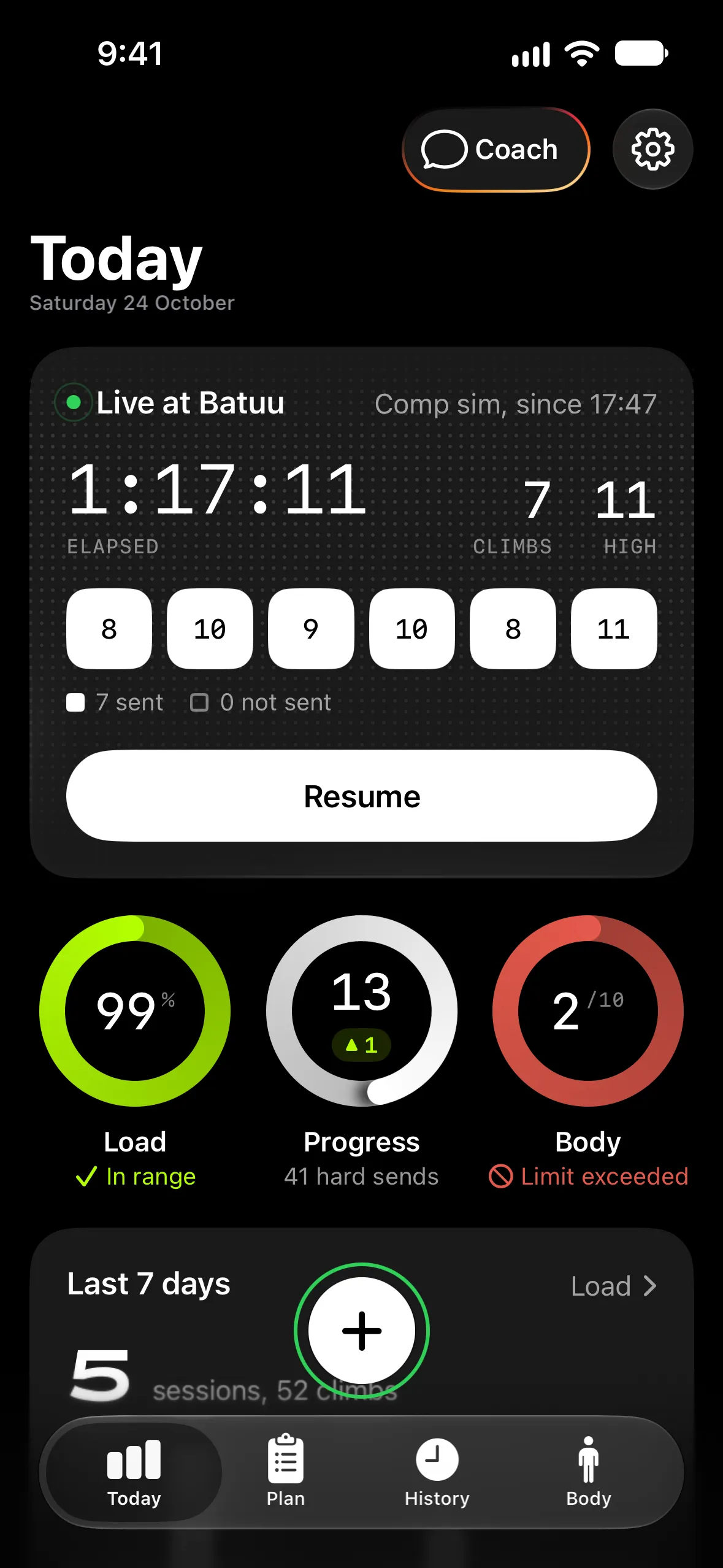
- The Load ring on Today turns lime in range, amber when spiking and stays neutral when light.
- Load detail shows the last 8 weeks, each against its own usual week, and lists the sessions that counted this week.
- Load rules from Body, like "Max 2 crimpy sessions a week" while a finger heals, are separate: they count sessions you and your physio set, not Load. How to track an injury.
- With Ascent Pro, the Coach reads your Load when it suggests a change to your plan. It proposes; your load rules, taper and injury limits decide, and nothing changes until you accept.